
16237. (photo) Lieutenant Commander Stephen S. Yeandle, aide to the Commandant c.1925.
Welcome to Kenrick A. Claflin & Son
Featured on our web site and in our monthly web catalogues are new and out-of-print books, documents, post cards, photographs, maps and charts, engravings, lithographs, uniforms and insignia, tools, lamps, lens apparatus, equipment and apparatus and much more relating to these heroic services.
We now issue most of our catalogues on line rather than by mail. This allows us to issue more catalogues and feature more items, with better photos and descriptions. Let us know your email address and we will email you monthly as our catalogues are posted.
Type in your search word. After hitting Enter you will automatically be brought back to this page. Scroll down to this spot to see the results of search. Pages containing your search word will be listed. You will be allowed to click on the pages found. When on each page, Windows Explorer will allow you to use Ctrl + F to bring up a search box for that page. Type in your search word again and hit “Enter”. You will be taken to that item.
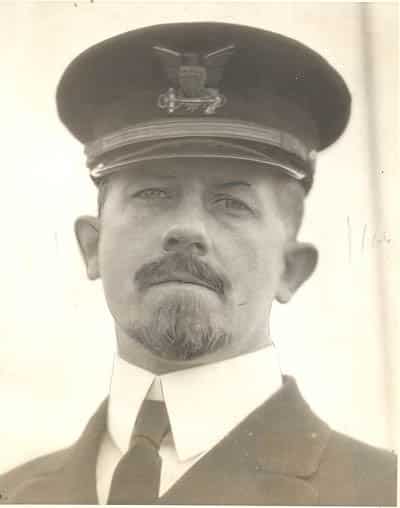
16237. (photo) Lieutenant Commander Stephen S. Yeandle, aide to the Commandant c.1925.
16237. (photo) Lieutenant Commander Stephen S. Yeandle, aide to the Commandant c.1925. Clear, close, original 8” x 10” press photo shows excellent detail of Lieutenant Commander Stephen S. Yeandle, aide to the Commandant c.1925. Commander Yeandle had a long career in the Coast Guard, distinguishing himself by his enthusiasm and his ability to find solutions to problems. CGavaition.org notes that: “It was at Section Base 7, located at Gloucester, Massachusetts that LCDR Carl Von Paulson, a Coast Guard Aviator and the Commanding Officer, approached LCDR Stephen S. Yeandle, aide to Commandant Billard, with the idea of utilizing aircraft to search and locate both blacks [The large smuggling ships were referred to as Blacks because they operated without running lights] and small boats making a run for shore. LCDR Yeandle thought the concept had merit and approached the Commandant who approved the idea but no funds were available. A Navy surplus Curtiss OU-1C was located and an agreement was made for the Coast Guard to utilize it for a period of a year. It initially flew out of the Naval Reserve Air Station at Squantum, Massachusetts in land plane configuration and then operated out of a make-shift tent-hangar located on Ten Pound Island in Gloucester Harbor reconfigured as a floatplane. The first use of an aircraft to chase a rum-runner was on 20 June 1925. The OU-1C assisted in the first capture of a rum runner with aviation support on 24 June 1925.” Photo is b/w and includes date and name on back. Dated May 19, 1925. Clear, close view. (VG). $44.