
33053. Darling, Warren S. Quahoging Out of Rock Harbor 1890-1930. Darling. 1984.
Welcome to Kenrick A. Claflin & Son
Featured on our web site and in our monthly web catalogues are new and out-of-print books, documents, post cards, photographs, maps and charts, engravings, lithographs, uniforms and insignia, tools, lamps, lens apparatus, equipment and apparatus and much more relating to these heroic services.
We now issue most of our catalogues on line rather than by mail. This allows us to issue more catalogues and feature more items, with better photos and descriptions. Let us know your email address and we will email you monthly as our catalogues are posted.
Type in your search word. After hitting Enter you will automatically be brought back to this page. Scroll down to this spot to see the results of search. Pages containing your search word will be listed. You will be allowed to click on the pages found. When on each page, Windows Explorer will allow you to use Ctrl + F to bring up a search box for that page. Type in your search word again and hit “Enter”. You will be taken to that item.
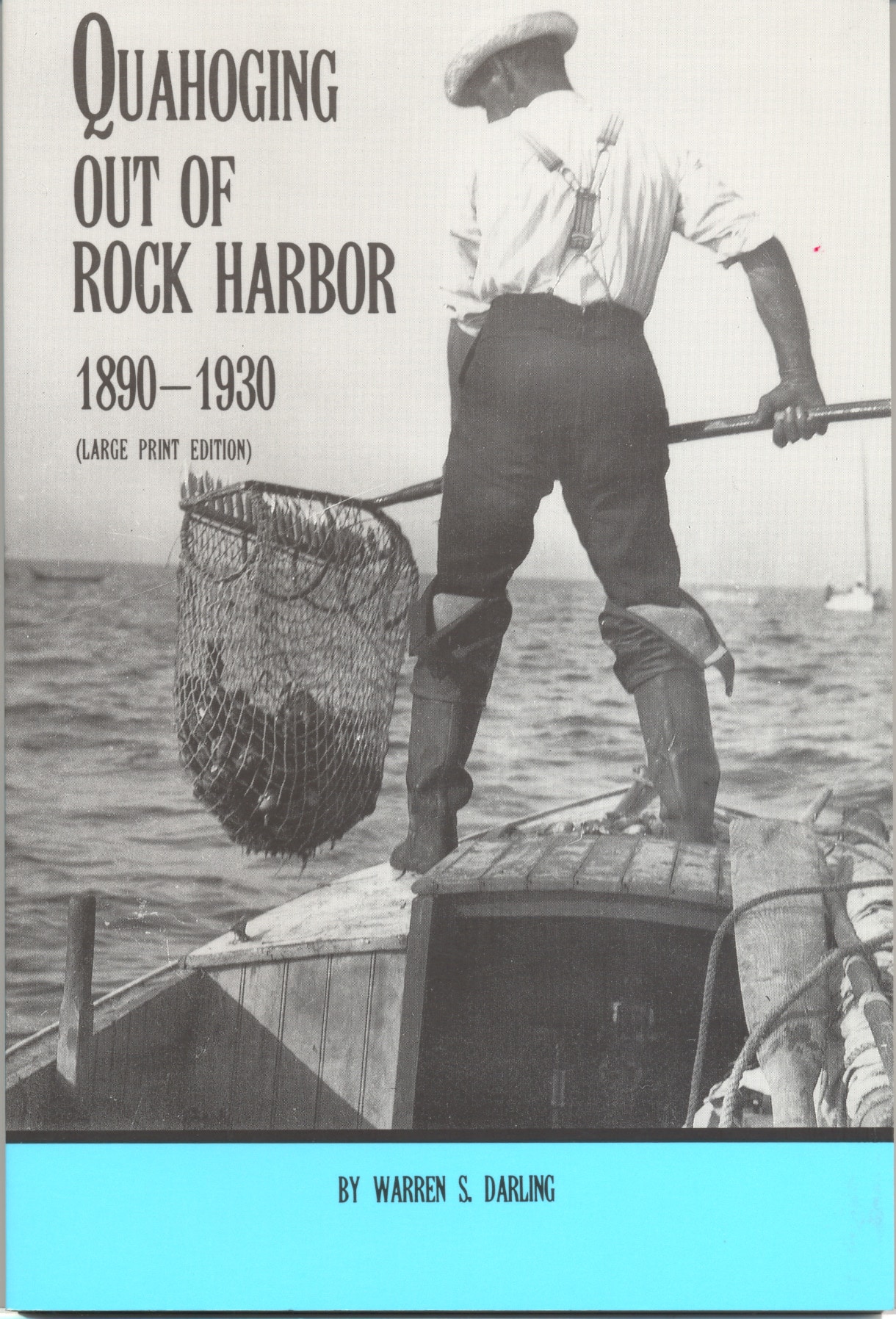
33053. Darling, Warren S. Quahoging Out of Rock Harbor 1890-1930. Darling. 1984.
- Darling, Warren S. Quahoging Out of Rock Harbor 1890-1930. Darling. 1984. 60p. Soft wraps. Captain Tom Smith grew up in Orleans and remembers going down to Rock Harbor to see the fishing boats when he was a kid. “There has always been a little quahog fleet in there,” Smith recalls. The quahog industry has been as constant as the tides. “That’s what helped shape the harbor,” said Captain Chris Viprino, a newcomer to the stalwart group. “We are right around the 100-year anniversary.”And that’s a century with powered boats. Clammers heading out of the “crick,” as they called it, date back to at least 1890. Author Warren S. Darling, the son of Nathan who owned the Ella B, writes today about the early days of the commercial industry. The early captains used catboats, almost as wide as they are long, 28 feet and sturdy. There were no dredges in the early days, so hand raking brought the harvest. Back then, according to Darling, the quahoggers made their own raking poles, often several because of the differing depths of the water. “Successful raking depended almost as much on the pole as the man using it. However, a pole that helped the rake to fish just right depended on how it was made,” he wrote. Experience some of the joy of the author when quahoging out of Rock Harbor. (M). $6.